
From a three-vendor services RFP to a national defence solicitation, the failure modes are identical: competing stakeholders, missing suppliers, and decisions no one will defend. Sextant fixes the infrastructure.
You focus on the outcome.
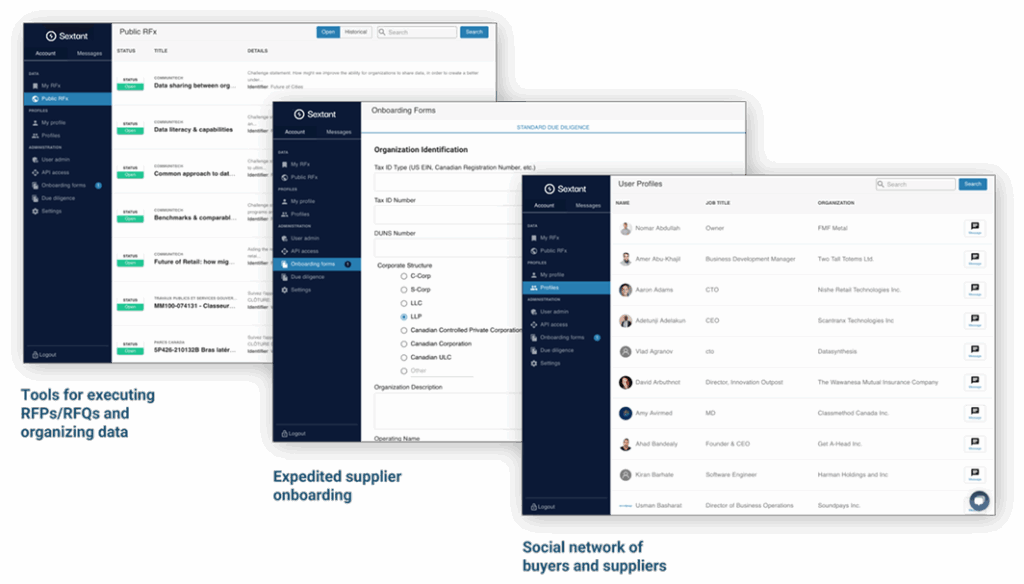

Technology doesn’t fix problems. People do. Sextant is built around that fact — it adapts to how your team works, not the other way around.
Success doesn’t come from features. It comes from understanding how procurement teams actually work, then putting the right tools and agents to work on their behalf.
The problem is never the procurement itself. It is always the coordination underneath it. The same failure modes appear at every scale, every sector, every budget cycle. The stakes change. The dysfunction does not.

The friction is invisible at first. By the time it surfaces, it has already cost you weeks. Every procurement involves people with different priorities, different levels of readiness, and different definitions of success. Without a structured environment to surface those differences early, they compound quietly — until a missed deadline or a capability mismatch makes them impossible to ignore. This happens at every scale.

Suppliers know things your team doesn’t. Excluding them costs you. When requirements are written without supplier input, they are written without market knowledge. The result is specifications that look precise on paper and perform poorly in the field — attracting the wrong vendors or discouraging the right ones. More competition starts with a better process. A clear, professional solicitation signals that your organization is serious. Suppliers respond accordingly.

Gut feel is not a defensible evaluation methodology. Scoring rubrics written as afterthoughts produce outcomes nobody fully owns. Evaluators work from different versions of the same document. Decisions are made in hallway conversations that never make it into the record. The winning vendor is sometimes right. The audit trail is almost never adequate. Gut feel is not a defensible evaluation methodology. Scoring rubrics written as afterthoughts produce outcomes nobody fully owns. Evaluators work from different versions of the same document. Decisions are made in hallway conversations that never make it into the record. The winning vendor is sometimes right. The audit trail is almost never adequate.

Email was not designed for multi-stakeholder procurement. Neither were spreadsheets. Legacy platforms impose enterprise complexity on organizations that need agility. They demand you restructure your process around the software. Mid-market organizations, government units, and enterprise divisions need a platform that adapts to how they already work — not one that treats them as a smaller version of a large company.
Sextant AI is a collaborative procurement platform built for complex, multi-stakeholder RFPs. It brings every party — buyer, evaluator, prime contractor, subcontractor, new entrant — into a single shared workspace. Authority is clear. Decisions have owners. The audit trail is automatic. The process moves. It works for a non-profit coordinating a joint municipal procurement. It works for a mid-size enterprise running an independent divisional RFP. It works for a national defence solicitation involving multiple federal agencies. The platform is the same. The underlying problem it solves is the same. Only the scale changes.

Every stakeholder in one place, from day one. Buyers, evaluators, suppliers, and subcontractors work in a single shared environment with role-based access, structured communication, and requirements gathering built into the workflow. No missed emails. No version chaos. No capability mismatches from suppliers engaged six months too late.

Authority is clear. Decisions have owners. Nothing stalls. Accountability gaps are procurement killers at every scale. Sextant structures the process so every decision point has a clear owner, every stakeholder knows their role, and competing interests surface before they become blockers. The process moves because the platform makes stopping harder than continuing.

Every decision. Every approval. Every version. Permanent and transparent. The audit trail builds itself in real time. Every action is logged — who said what, when, under what authority. Your compliance record is ready for scrutiny on demand, whether it comes from internal leadership, external oversight, or a vendor challenge. You are not reconstructing the story after the fact. It is already written.

The knowledge doesn't leave when the person does.
Every RFP you run on Sextant compounds in value — your document preferences, evaluation criteria, supplier performance, and requirement patterns accumulate into an organizational asset that outlasts any individual on your team. Over time, Sextant becomes the institutional memory of your procurement practice and the living network of your supplier relationships: a record of every decision ever made, and a map of every relationship ever built.
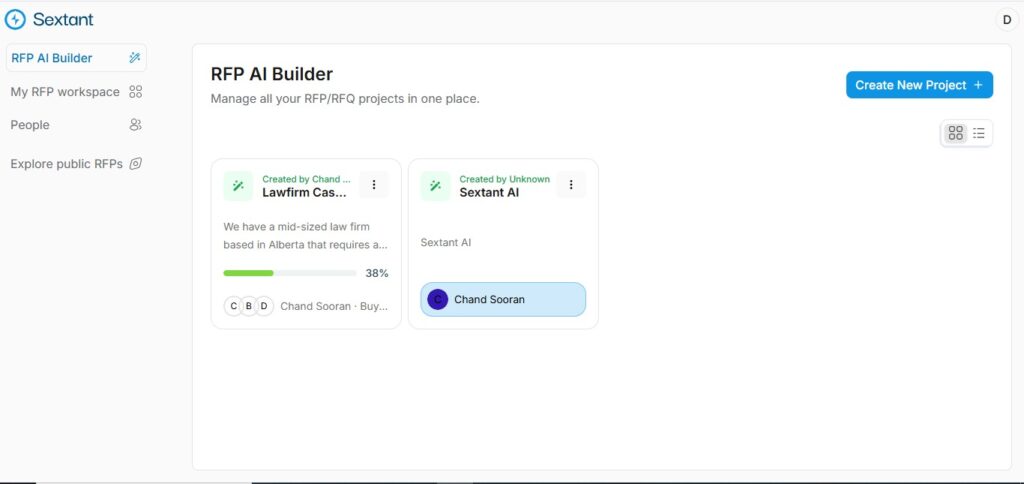
Pilot — Sextant’s AI co-pilot — is not a document generator. It is an interview-driven coordination engine. It works through your stakeholder committee, section by section, synthesizing requirements into procurement-ready drafts. Every suggestion requires human review. Every decision stays with your team.

Instead of one procurement officer chasing fifteen people across forty email threads, Pilot conducts structured intake interviews with each stakeholder. Requirements arrive organised, reconciled, and ready for drafting. Weeks of coordination compressed into days.

Pilot learns your document preferences, terminology, and evaluation criteria. Institutional knowledge that currently lives in one person’s inbox becomes a platform asset. New staff onboard faster. Consistency is automatic rather than aspirational.

Design RFPs together with inputs from end users, technical reviewers, finance, and legal — in an interface as intuitive as the tools your team already uses. Stakeholder buy-in is built into the process rather than negotiated after the fact. When people shape requirements, they own the outcome.

Evaluate supplier proposals collaboratively using Sextant’s scoring tools. Every evaluator works from the same information and the same rubric. Scores are calculated transparently. The audit trail is automatic. Decisions are defensible to internal leadership, oversight bodies, and — if it comes to it — a vendor challenge.
Sextant AI was built for organizations that run procurement the hard way — not because they want to, but because they have never had the right tools. That includes government agencies managing multi-party solicitations, mid-size enterprises running divisional RFPs without enterprise resources, non-profits coordinating joint procurements, and SMEs buying critical services for the first time. The platform scales with you. The underlying problem it solves does not change.
Collaborative tools designed for easy stakeholder input work the same way whether your committee has five people or fifty. Email chain chaos disappears. Contributions arrive in a structured format. Approvals happen faster because everyone has already been heard.
Human-supervised AI accelerates RFP drafting, analysis, and supplier matching. Organizations moving from manual processes typically achieve 30–50% cycle time reductions. Every AI suggestion is reviewed and approved by a human before it advances. Speed with maintained quality — not speed at the cost of it.
If your team uses Figma, Notion, or Google Docs, they will find Sextant immediately familiar. Minimal training. Maximum adoption. No dedicated IT resource required. Implementation in days, not months.
Pilot helps identify, vet, and solicit qualified suppliers based on category intelligence from public and private data repositories. Expanding the competitive pool — especially beyond your existing relationships — drives better outcomes and stronger compliance with competitive procurement obligations.
Eighteen-plus implementations. Government agencies. Non-profits. Commercial organizations. Joint procurements crossing sectors and jurisdictions. The coordination problem looked different in every case. The platform solved it the same way.
“EdgeworthBox was tremendously helpful in our Future of Retail program. We regularly issued joint requests for proposals from startups on behalf of multiple corporate sponsors, and EdgeworthBox massively reduced the complexity of managing these events. The collaboration suite — including messaging and evaluation tools — helped us engage more effectively with startups, resulting in higher response rates and significantly more relevant submissions.
“A specific example illustrates this value. A startup called GeoMate initially wasn’t interested in responding to one of our RFPs. Through the platform’s messaging capabilities, they were able to communicate directly with our project lead and learned that their initial understanding of the requirements was incorrect. This dialogue led them to submit a strong proposal. The Region of Waterloo selected GeoMate, leading to a contract. The success of this project subsequently contributed to GeoMate’s selection by the United Nations for a large multi-national deployment of their solution.
“The team was responsive and worked collaboratively with us to ensure the platform met our specific needs. We would confidently recommend their solution to other organisations managing complex procurement processes with multiple stakeholders.”
* EdgeworthBox rebranded as Sextant AI in 2024.
“As a sourcing tool, Sextant proved to be a robust and intuitive platform, bringing simplicity to the procurement of a significant and complex client requirement.”
GeoMate had misread the requirements of a Communitech RFP and decided not to respond. The platform’s direct messaging capability let them ask a question. The project lead clarified the scope. GeoMate submitted. The Region of Waterloo selected them. That contract became a reference that led to a United Nations multi-national deployment.
A procurement that almost produced one fewer qualified proposal instead produced a UN-scale outcome — because the platform made it easy for a supplier to ask a question and get a straight answer.
This is what good procurement infrastructure does. It does not just manage a process. It creates the conditions for the right match to happen.
The platform didn’t just reduce administrative burden. It changed which proposals got submitted.
Communitech used Sextant to issue joint Requests for Innovation on behalf of multiple corporate sponsors simultaneously. The collaboration suite coordinated requirements across sponsor organizations, managed supplier communications, and ran evaluation with multiple reviewers from different firms — without the coordination overhead collapsing into chaos.
The GeoMate outcome is the clearest proof of what that infrastructure makes possible. A qualified supplier who had already decided not to respond asked one question, got one clarifying answer, submitted a strong proposal, won a regional government contract, and subsequently secured a United Nations multi-national deployment. That chain of outcomes was made possible by a platform that kept the door open when it would otherwise have closed.
CUTZEB was coordinating multiple buying and funding organizations, each with their own teams, systems, and procurement obligations. Without Sextant, they would have drowned in emails and spreadsheets.
Sextant provided the coordination layer. Each participating organization retained its own access controls and visibility permissions. Requirements were gathered collaboratively across teams that had never worked together in a structured process before. Suppliers — including bidding consortia — received a clear, professional engagement experience that made participation straightforward.
The result: higher competition, stronger proposals, and a procurement that remained fair, transparent, and fully compliant throughout. The first large-scale joint RFP in Canadian municipal procurement. Live on Sextant within days of receiving project details. CUTZEB reference available on request.
A board-level mandate requiring expert consultation across regional subsidiaries in multiple jurisdictions. Completed without a single procedural challenge or compliance gap — in a procurement environment where both were near-certainties under the previous approach.
Whether you are running procurements on email and spreadsheets, or using enterprise software that was never built for your scale, this is what the comparison looks like.
Dimension | How You’re Doing It Now | With Sextant AI |
Philosophy | Technology defines the process. | People and process define how technology helps. |
Starting point | Blank document. Email threads. Hope. | Your existing process, digitized and structured from day one. |
Stakeholder input | Chasing people. Reconciling versions. Repeating yourself. | Structured intake. Everyone contributes once, in the right format. |
Supplier engagement | Your existing contacts. Interested parties only. | Open, structured dialogue. Qualified suppliers stay in the process. |
Drafting time | Weeks to months. | Days. AI drafts. Humans approve. Every time. |
Evaluation | Spreadsheet scoring. Weak audit trail. | Collaborative scoring. Transparent rubric. Automatic permanent record. |
Audit trail | Reconstructed after the fact, if at all. | Built automatically throughout. Ready on demand. |
Implementation | Months of IT involvement. | Live in 2–3 weeks. Configured to how you already work. |
Support | IT helpdesk tickets. | Procurement consultants who understand your process. |
Cost to scale | Per-user licensing. Expensive as you grow. | Enterprise-wide. Unlimited seats. Fixed and predictable. |
Adoption | Training programs nobody finishes. | Intuitive. Your team is using it within days. |
For years, we operated as EdgeworthBox, working with government and commercial clients across Canada and the UK. Eighteen-plus implementations. One hundred percent implementation success. Zero abandoned RFPs. Now, as Sextant AI, we bring that institutional knowledge to complex organizations through technology that adapts to how teams actually operate — not the other way around.
We are AWS Public Sector Partners, hosted in both AWS US and AWS Canada. Our team brings decades of combined experience from IBM, Microsoft, and leading advisory firms.
A note from the founder
My career began in financial markets. Every day, trillions of dollars change hands in those markets — including in extraordinarily complicated instruments — with a reliability so close to perfect that we barely think about it. If a major exchange went dark for a single day, the cascading failures would be impossible to unwind. The matching of buyers and sellers, the settlement of transactions, the flow of capital to where it can do the most good: financial markets have spent decades building ruthlessly efficient infrastructure for all of it.
When I moved into the startup world and began working with organizations in and around the public sector, I encountered procurement — and I was genuinely taken aback. Here was another critical matching process: buyers who needed solutions, and suppliers who had them. The economic stakes were enormous. The social consequences of getting it wrong were real. And yet the process itself seemed frozen in time. It took too long. It cost too much. It consistently failed to connect buyers with the right solution, from the right supplier, at the right price. And it did an even worse job of helping suppliers — especially smaller ones — find and build long-term relationships with the clients they could best serve.
What struck me most was the human cost of that failure. Procurement officers buried in email. Suppliers treating the RFP process as a compliance exercise rather than a genuine opportunity. Stakeholders who had already mentally checked out before the evaluation was finished. The system had become so administratively taxing, so structurally unfair to anyone without enterprise resources, that it undermined the very goals it was designed to achieve.
Much of that dysfunction had a single root cause: obstacles to collaboration and coordination built into the way organizations executed. The tools didn’t match the work. The people who needed to align had no shared environment in which to do it. The institutional knowledge that should have accumulated over years of procurement practice was scattered across inboxes and shared drives and people’s heads.
I had spent my entire career managing risk and designing mechanisms for matching buyers and sellers in ways that create value for both sides. I knew exactly what the problem was. And I wanted to do for procurement what the Bloomberg terminal did for capital markets: take a process that was technically complex, institutionally important, and operationally painful, and give the people who run it the infrastructure to do it with confidence, speed, and control.
The real economy deserves the same rigor that financial markets take for granted. That is what Sextant AI is built to provide.
Chand Sooran
Founder & CEO, Sextant AI
Account setup and platform access. Virtual training for your procurement team. First pilot procurement initiated with our support alongside you. Two hours to map your current workflow, identify your bottlenecks, configure templates starting from yours — not ours — and set up stakeholder roles and permissions.
Not a simulation. A live RFP with our support in place. Your team learns by doing. We observe, adapt, and calibrate Pilot to your document preferences, terminology, and evaluation criteria. Full platform deployment for all users begins here.
Pace increases. Ongoing procurement consultant support continues as you accelerate. Iterative improvement built into every subsequent procurement. The platform gets more useful the more you use it.
Why implementations succeed: we start with process understanding, not software training. The platform fits the way your team works. Adoption is immediate.
We would rather have an honest conversation about fit than start an implementation destined to fail. Read the criteria below. If you meet them, we have an offer for you.
No commitment. One real procurement, on the actual platform, with our team alongside you.
One complete RFP | Run a real procurement — not a simulation — from requirements through to evaluation and award. |
Supplier onboarding | Invite your suppliers and test the engagement experience. See exactly how they interact with your solicitation. |
Internal collaboration | Test the platform’s messaging and coordination tools across your internal team. No more email chains. |
Evaluation tools | Build your scoring rubric, run your evaluation, and produce a defensible award record — all within the platform. |
Full platform access | Use the complete coordination, governance, and auditability infrastructure for the duration of your test RFP. |
Pilot AI — our interview-driven AI co-pilot is a paid feature. The free test gives you the full coordination and evaluation infrastructure. Pilot is what you unlock when you become a paying customer.
One Month. One RFP. That’s the boundary.
The free test is structured to give you a genuine experience of the platform on a real procurement — not an open-ended trial that never produces a conclusion. You have one month from the date of access to complete your test RFP. The boundary is what makes the result meaningful.
We’ll review your application and confirm whether the free test is a fit. If it is, you’ll have access within 48 hours.
The free test is not a gateway to an automatic invoice. It is a structured evaluation — for both of us.
You have one month and one RFP. Use the platform for real — with your actual stakeholders, your actual suppliers, and your actual requirements. The test is designed to produce something useful regardless of what happens next: a completed, auditable, defensible procurement record.
At the end of your test period, we sit down together. Our procurement consultants — not a sales team — walk through what worked, what didn’t, and what the platform revealed about your procurement process. This conversation is genuinely useful whether you become a paying customer or not.
We revisit the qualification criteria together. Did the platform do what it was supposed to do in your environment? Did your team engage with it the way the process requires? Were the original qualification criteria met in practice, not just on paper?
We invite you to become a paying customer.
We will only bring you on as a paying customer if we genuinely believe the platform will work for you. If the test reveals that the fit is not there — for any reason — we will tell you directly. We would rather lose a sale than set up an implementation that fails.
This is not a formality. We have walked away from prospective customers before. We will do it again. Our 100% implementation success rate exists because we are selective about who we work with — not because every implementation is easy.
The free test is the beginning of a relationship, not the end of a sales process. We only build relationships we think will last.
One complete RFP run on the full platform within one month of receiving access. You can invite suppliers, test the onboarding experience, use the internal messaging and collaboration tools across your team, and run a complete evaluation using the platform’s scoring tools. Pilot AI — the interview-driven AI co-pilot — is not included in the free test. It is a paid feature.
Pilot is the most differentiated part of the platform — and the most powerful. The free test is designed to let you experience the coordination infrastructure: stakeholder collaboration, supplier engagement, evaluation tools, and the audit trail. Once you have seen how the platform handles the process, Pilot is what takes it from fast to transformational. We want you to appreciate the foundation before you experience the acceleration.
The free test ends. We have a consultation regardless — to understand what got in the way. If the obstacle was organizational rather than a product issue, we will tell you. If it makes sense to try again under different conditions, we can discuss that. But the one-month boundary is firm. It is what makes the test a test rather than an open-ended trial.
It means we have reviewed the evidence together — how your team engaged with the platform, whether the procurement process ran as it should, whether the original qualification criteria held up in practice. If the test reveals that readiness was assumed rather than real, we will say so. Being invited to become a paying customer means we have confidence the engagement will be successful. We do not extend that invitation otherwise.
If you run three or more RFPs annually with five or more stakeholders involved in each, yes. The coordination overhead Sextant eliminates exists at every volume. The question is not how many RFPs you run — it is whether the ones you run are producing the outcomes they should.
Most procurement platforms handle contract management, spend analytics, and supplier records well. Sextant focuses exclusively on the RFP process: drafting, stakeholder coordination, supplier engagement, and evaluation. It fills the gap where most organizations — including those with enterprise systems — are still operating on email and spreadsheets. It connects via API.
Your data is yours. Hosted in AWS Canada for Canadian clients and in the US for everyone else, it never leaves your environment without your explicit permission. Purpose-built for organizations that require data sovereignty, including government agencies with strict information management requirements.
Yes. Apply and tell us where you’re uncertain. We would rather have that conversation upfront than discover a misfit three weeks into a test. The application is a conversation, not a form.